
January 2023
Welcome to 2023. We hope you had a happy Christmas and New Year and look forward to the year ahead.
Here is the latest from our farm team at Mount Vets. If you would like any further advice or would like us to cover something in the next newsletter, please call us on 01823 663384 or contact us here.
We want to hear your feedback… Leave us a review!
Our new website is now live. We hope you enjoy an easier navigation through the pages and have had the opportunity to look at the new information that we have added. We value your feedback and comments and would appreciate if you could take the time to leave us a review! Please follow the link to share your thoughts. https://g.page/r/CTSyP_UXvSPIEAI/reviewDigital Dermatitis
Digital Dermatitis in cattle is a very contagious infection usually affecting the heel bulbs but can sometimes be found in between the digits or at the coronary band. It is caused by a group of bacteria called Treponemes that live in deep in the skin and are also found in the environment, especially slurry. It is estimated that up to 43% of dairy herds in the UK are infected with Digital Dermatitis but this figure could be higher as it can hide undetected.
Digital Dermatitis lesions go through various stages and can be classified using a scoring system M0-M4. The most common presentation is a round, ulcerated lesion found on the heel bulb. DD lesions cause significant pain to cattle and therefore have can a significant impact on milk yields and reproductive performance.
As with all infectious diseases, the best way to control DD is to never bring it onto the farm. In practice, this is easier said than done as some infected cows can have inactive lesions that do not cause pain but can be a source of spread. When purchasing new cows, biosecurity best practice should be followed which includes asking about the DD status of the home farm and examining the feet of bought in cows for signs of DD lesions.
Once DD is on farm, control centres around keeping as clean an environment for the cattle as possible and the bacteria thrive in dirty conditions. Regularly scraping out passageways and keeping sheds clean is a priority.
Routine foot bathing is also an excellent method for keeping cattle feet clean and reducing exposure to DD bacteria. There are a range of appropriate foot bath chemicals such as Formalin, Copper Sulphate and Zinc Sulphate. Foot bathing should be done several times a week if not daily. For this to be practical, foot baths should be designed with ease of use in mind and should be safe to operate and the chemicals are often harmful to humans.
For individual cows with active DD lesions, picking their feet up to examine them properly is a must. The lesions can then be cleaned of any faecal material and dried thoroughly before a topical antibiotic spray is applied. The spray should be left to dry before the foot is released.
Dry cows and youngstock are often forgotten about regarding DD control. Both groups can be important reservoirs for infection and should regularly examined and run through the foot baths.
For any further questions regarding DD control i.e. foot bath design/concentration, please contact us at the practice.
Winter Feeding for In-Calf Heifers
The nutritional demands on spring-calving heifers for the winter period are considerable – on top of maintaining their own body condition they, and their calves, are still growing as well. Getting nutrition correct here is key to achieving heifers that are fit and well grown (without being overfat) which will hopefully calve down with minimal assistance and have the resilience to provide for their calf whilst also maintaining their condition into the next breeding period. Excessive condition loss around and after the calving period, can have serious knock-on effects to a heifer’s fertility into the next breeding period and reducing the odds of them conceiving early within the next bulling period.
Aim for a body condition score of 2.75-3 at point of calving. They should have gained approximately 85% of their adult body weight by this time, highlighting the importance of not bulling heifers until they are at least 60% of their adult bodyweight. Avoid allowing heifers to lose or gain more than 0.5 of a body condition score over the winter period. Heifers calving in at the correct BCS are less likely to have a prolonged post-calving anoestrus period and therefore conceive earlier into the next breeding period.
Ensure at least 75cm of feed space per heifer to allow them to all feed at once. If housed in cubicles, stock to 90% occupancy before moving to loose housing either 2 weeks before calving or at point of calving. Loose housed heifers should have a straw bedded area of at least 3.5-4m2 per head, giving a total housed area of 5-6m2 per head. One of the best investments you could possibly make for a smoother calving period is a calving gate! The best models have a removable caesarean bar and should be installed to allow us access to the cow or heifer’s left-hand side.
Especially if calving your heifers down at 2 years old, these girls should be a separate management group to the cows from weaning to point of calving (in an ideal world, until after second bulling even!) If they’re having to compete with much bigger, mature cows for feed they’re already on the back foot for feed intakes. Prioritise your highest quality forage for your in-calf heifers, as their needs are much greater than the cows.
To account for maintenance, growth of approximately 0.5kg/day and her pregnancy, an average 500kg heifer will require 88-90 MJ ME per day for most of the winter. This same 500kg heifer will likely have a dry matter intake (DMI) of approximately 10kg per day.
During mid-pregnancy, the crude protein (CP) requirement is approximately 11%, increasing to 14% in the last month before calving to accommodate calf development and colostrum quality. A protein supplement can be very useful in achieving this higher CP requirement, as can reducing the amount of straw fed, and increasing the amount of silage fed out.
Trace element requirements are also highest for in-calf heifers relative to the rest of the herd so ensure their needs are being met with boluses containing copper, cobalt, selenium, and iodine. It may well be wise to test trace element and nutritional status using metabolic profiling 6 weeks or more after they have settled onto the winter ration.
EXAMPLE DIET | MID-PREGNANCY (kg) | PRE-CALVING (kg) | ||
|---|---|---|---|---|
OPTION 1 | OPTION 2 | OPTION 1 | OPTION 2 | |
SILAGE 35% DM, 10.5 MJ ME, 14% CP | 21 | 15 | 25 | 18 |
STRAW 85% DM, 6MJ ME, 4% CP | 3 | 3 | 1 | 1 |
WHOLECROP 40% DM, 10.5 MJ ME, 9.5% CP | – | 5 | – | 5 |
PROTEIN SUPPLEMENT
eg rapemeal | – | 0.3 | 0.5 | 0.8 |
Are you over worming your ewes pre-lambing?
The answer, if you are worming your ewes before lambing/turnout, is almost certainly yes!
WHY DO WE WORM EWES BEFORE LAMBING?
You may be surprised to learn that we’re rarely doing this for the benefit of the ewe, as most adults have developed a good protective immunity against most gut parasites by this stage in their life – the exceptions being liver fluke and the barber’s pole worm (Haemonchus). The reason historical advice has recommended worming ewes is to reduce the “Peri-Parturient Rise” (PPR) in worm egg output that comes as ewes’ immune systems are weakened around lambing. The idea is that by worming ewes, we control the increase in worm egg output by the ewes as they go back out onto grass and start loading pasture burden for the more susceptible lambs.
SOUNDS LIKE IT AIN’T BROKE…. WHY FIX IT?
As wormer-resistance looms larger and larger as a very real current issue, we all have a duty to be more responsible stewards of these essential drugs. Purely and simply, we do this by using less wormer and only when it is necessary. Blanket treating all ewes, when most of them are not in need of treatment, will certainly increase the risk of wormer resistance developing on your farm.
Luckily, we can target worming at the ewes that are most likely to have a significant degree of PPR – saving you money and slowing the rate of resistance developing. We used to think that the chance of PPR developing increased with the number of lambs on board, however recent research has uncovered that in fact, body condition score and nutritional strain are a better indicator of PPR risk.
As a rule, fit ewes (BCS 3 and above) are very unlikely to require worming, regardless of the number of lambs they are carrying. Worming, if necessary, should be targeted to ewes condition score 2.5 or less. Try to ensure that a minimum of 20% of any mob is left untreated. This will help carry over some “susceptible” worms onto the pasture after turnout, rather than solely a resistant population of worms.
Upcoming courses
FOOT TRIMMING
7th March 2023 | 10:30am-4pm
Are you a young dairy farmer or dairy farm worker that is keen to learn how to carry out routine foot trimming on your farm?
If so, this course is for you!
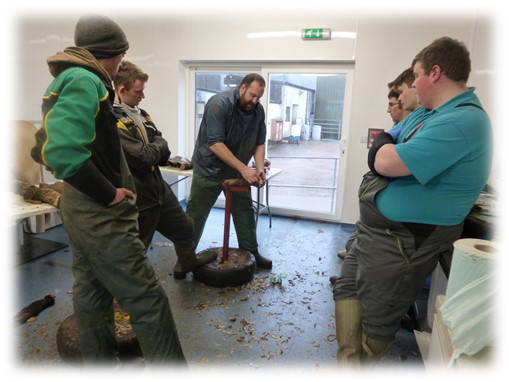
The day aims to teach the Dutch 5 step technique, which is used all round the world. This course will teach you the rudimentary techniques as well as allow you to practice on several feet on the day. You will also learn more about the overall control of lameness within the herd.
The course covers:
☑️ Foot anatomy
☑️ The 5-step technique
☑️ Hands on foot trimming
☑️ Infectious and non-infectious lameness
☑️ Locomotion scoring
☑️ Bandaging and blocking feet
Course fees:
£25 if YFC age (with funding from Laura Persey Trust)
£100 for over YFC as an unsubsidised fee.
Please ring the practice to book your place on any of our courses on 01823 663384 or email farm@mountvets.com
Have a question about any of the topics covered in this newsletter?
If you need any assistance with the topics covered in this newsletter, please do not hesitate to get in touch with our experienced farm vets who will be able to help. Call 01823 663384, or contact us here.